
Moss as a predator? Photogenic Science reveals the beauty and humor in research
18. 12. 2025
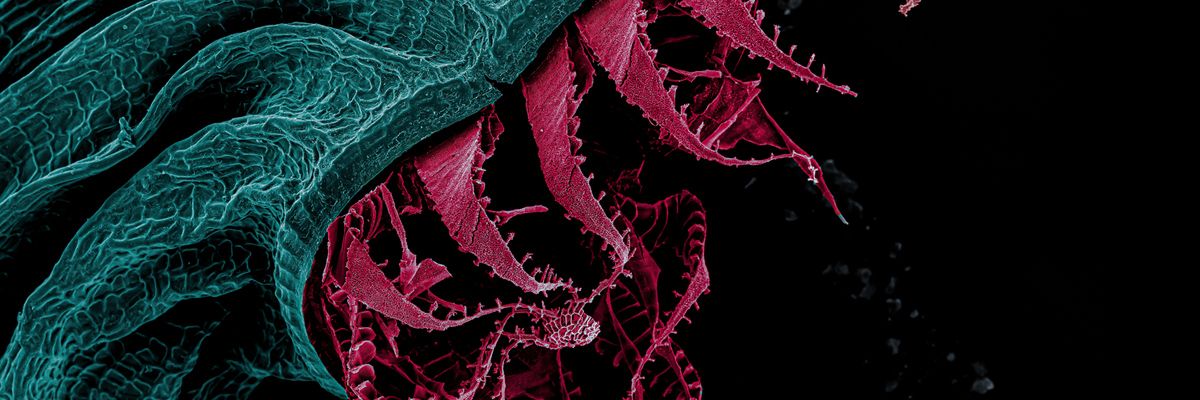
A photo of a moss capsule that resembles a deep-sea predator when magnified has won this year’s Photogenic Science contest. The winning image, “Anglermoss,” shows us that research can also uncover aesthetic beauty hidden from the naked eye. The Photogenic Science exhibition, on view at the Academy’s Science and Art Gallery on Národní Street in Prague from 4 December 2025 to 30 January 2026, showcases four dozen photos from the scientific realm.
Research can be a source not only of new insights but also of visual beauty. The images submitted to Photogenic Science, an in-house photo contest announced each year by the Czech Academy of Sciences (CAS) for its employees, attest to this. This year’s twelfth edition brought together a total of 238 photos by 81 contestants from 26 CAS institutes. An expert jury selected the 40 best images which together form the exhibition featured at the Science and Art Gallery on Národní Street in Prague.
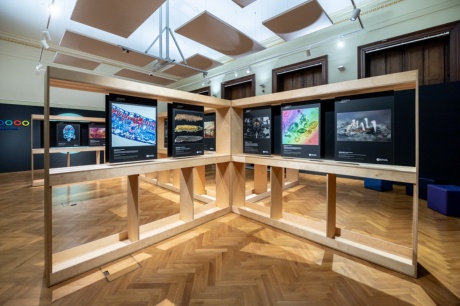
The Photogenic Science exhibition is on view at the Academy headquarters.
“The exhibition offers a glimpse into the world of research in labs and archives and the everyday work not only of scientists but of all staff. Through a photographic lens, this world takes on a new and often surprising form,” said Ondřej Beránek, Vice-President of the CAS, at the exhibition opening. He stressed that photography can capture processes that are too fast or too subtle to be perceived with the naked eye. “Photography brings us closer to structures and phenomena we do not normally see. At the same time, it speaks to people who are not directly involved in science. In today’s visually oriented age, this kind of language is especially important. An image can become one of the bridges between the complexity of scientific knowledge and the public.”
Markéta Pravdová, the long-serving chair of the expert jury, recalled that the contest was initiated more than a decade ago by the Fórum Věda žije! initiative. “By organizing the photo contest, our aim was to support the promotion and popularization of research, and this has worked well over the long term. The photos also go on to live a second life in a representative calendar our institution puts out every year,” Pravdová explained. In recent years, Photogenic Science has crossed the borders of the Czech Republic and delighted audiences as far away as Taiwan. In 2024, to mark the tenth anniversary of the contest, the Photogenic Science exhibition was presented at the Chamber of Deputies of the Parliament of the Czech Republic.
Anglermoss: A moss capsule that transforms into a predator
The winner of the main category of Photogenic Science this year was “Anglermoss” by Tomáš Figura from the Institute of Botany of the CAS. The author captured the metagenesis of mosses – a topic whose complexity strikes fear into many a botany student. The image shows a seta (stalk) with a capsule (sporophyte) from which spores have already been released. The capsule mouth (colored red) resembles the teeth of a deep-sea predator about to seize its prey – in this case, a germinating pollen grain of common mallow (Malva sylvestris) that happened to fall by chance into the frame.
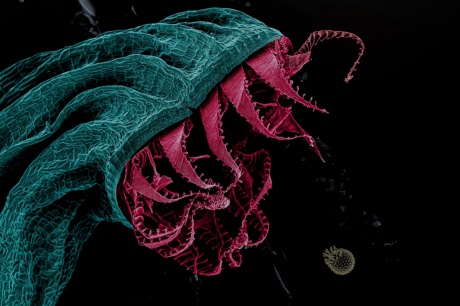
The winning photo in the main category, titled “Anglermoss.”
“I enjoy photography – whether I’m taking pictures for research, for pleasure, or for competitions,” Tomáš Figura said when receiving the award.
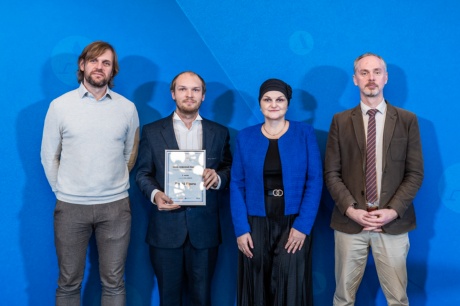
Left to right: Michael Komm from the Fórum Věda žije! initiative, the author of the winning photo Tomáš Figura, Markéta Pravdová, and Ondřej Beránek, Vice-President of the CAS.
Second place went to Jaromír Kopeček from the Institute of Physics of the CAS with his photo “Printed in Titanium,” which depicts the surface of the “medical” titanium alloy Ti-6Al-4V after chemical treatment. Third place was awarded to Lucie Najmanová from the Institute of Microbiology of the CAS for “Life After Life,” depicting soil bacteria (Streptomycetes) – producers of biologically active compounds, pigments, and the characteristic scent of wet soil.
Humor hot on our heels
“In addition to the main category, the contest also features a side category that changes every year,” Pravdová noted. This year’s theme, Scientists with a Sense of Humor, offered a light-hearted, playful look behind the scenes of scientific life. The submitted entries captured situational comedy, amusing moments, and even creative hyperbole – a common but rarely visible part of everyday work both in labs and in the field.
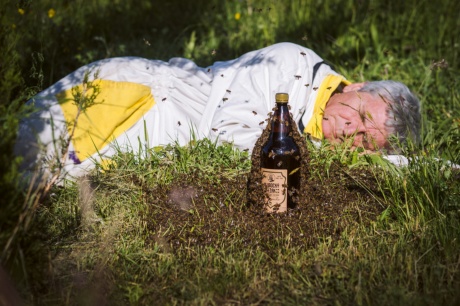
Bees, beer, and science communicator Václav Krištůfek in the winning photo in the contest category Scientists with a Sense of Humor.
First prize went to Václav Krištůfek from the Biology Centre of the CAS for “Sweet Dreams with Bee(r/s).” The enthusiastic science communicator and recipient of the Vojtěch Náprstek Honorary Medal for Merit in Science Popularization explained the circumstances under which the photo was taken. “One day, I was at an apiary, and a bush there was hanging heavy with a full ‘bag’ of bees. I called a colleague to come and take a picture of me with them. But the bees were tired and ended up ‘flopping’ off the bush into the grass. I lay down next to them and placed a bottle of lager beer in the frame as well. It was a moment – a happenstance – that produced a nice photo,” Krištůfek recalled.
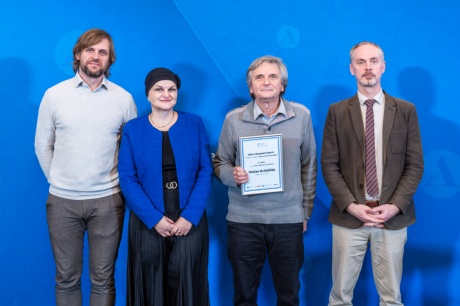
Left to right: Michael Komm, Markéta Pravdová, Václav Krištůfek (winner), and Ondřej Beránek.
Second place went to Pavel Lisý from the Institute of Geology of the CAS for “In the Pithos,” while third place was taken by Jiří Frolec from the Institute of Scientific Instruments of the CAS with “Levitating Steamship.”
The Academy Council of the CAS Award was presented to Michal Filippi from the Institute of Geology of the CAS for “Sun Set in Stone”. Awards for scientific fields went to Pavol Gajdoš from the Institute of Theoretical and Applied Mechanics of the CAS, Tomáš Figura from the Institute of Botany of the CAS, and Jitka Walterová from the Institute of Art History of the CAS.
In the public online vote on the Czech Academy of Sciences’ Facebook page, the winning photo was “Falling in Love with Your Work” by Petra Dragonidesová from the Institute of Archaeology of the CAS, Brno.
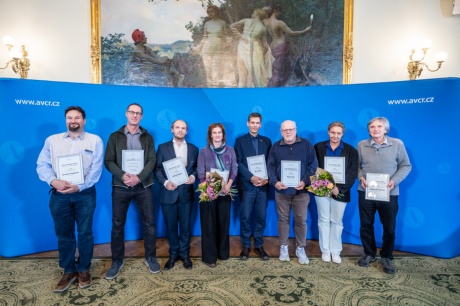
The exhibition runs until the end of January 2026
The Photogenic Science 2025 exhibition can be visited from 4 December 2025 to 30 January 2026 at the Science and Art Gallery at the headquarters of the Czech Academy of Sciences at Národní Street in Prague. It is open on weekdays from 10 AM to 6 PM, and admission is free.
Prepared by: Luděk Svoboda, External Relations Division, CAO of the CAS
Translated by: Tereza Novická, External Relations Division, CAO of the CAS
Photo: Jana Plavec, External Relations Division, CAO of the CAS
 The text and photos are released for use under the Creative Commons license.


Read also
- How does the Academy Council plan to strengthen the Academy’s role? Part 2
- How does the Academy Council plan to strengthen the Academy’s role? Part 1
- Ombudsperson Dana Plavcová: We all play a role in creating a safe workplace
- ERC Consolidator Grant heads to the CAS for “wildlife on the move” project
- A little-known chapter of history: Czechoslovaks who fought in the Wehrmacht
- Twenty years of EURAXESS: Supporting researchers in motion
- Researching scent: Cleopatra’s legacy, Egyptian rituals, and ancient heritage
- The secret of termites: Long-lived social insects that live in advanced colonies
- Two ERC Synergy Grants awarded to the Czech Academy of Sciences
- Nine CAS researchers received the 2025 Praemium Academiae and Lumina Quaeruntur
The Czech Academy of Sciences (the CAS)
The mission of the CAS
The primary mission of the CAS is to conduct research in a broad spectrum of natural, technical and social sciences as well as humanities. This research aims to advance progress of scientific knowledge at the international level, considering, however, the specific needs of the Czech society and the national culture.
President of the CAS
Prof. Eva Zažímalová has started her second term of office in May 2021. She is a respected scientist, and a Professor of Plant Anatomy and Physiology.
She is also a part of GCSA of the EU.