
The Academy to Boost Excellence and Careers in Research with New Programs
26. 01. 2026
How can researchers be more strongly supported in their careers, and how can we create an environment in which they turn their talent into excellent results? The Czech Academy of Sciences is introducing a revised support system that combines proven tools with new programs – the Academy of the Future and the ERC Incubator.
Do you have experience, contacts, and the ambition to focus on original research, yet find yourself facing questions about how to reconcile your next professional steps with your personal life? The new support programs offered by the Czech Academy of Sciences (CAS) take such situations into account as well. Their goal is to help researchers develop their careers smoothly while enabling CAS institutes to actively support their scientific aims.
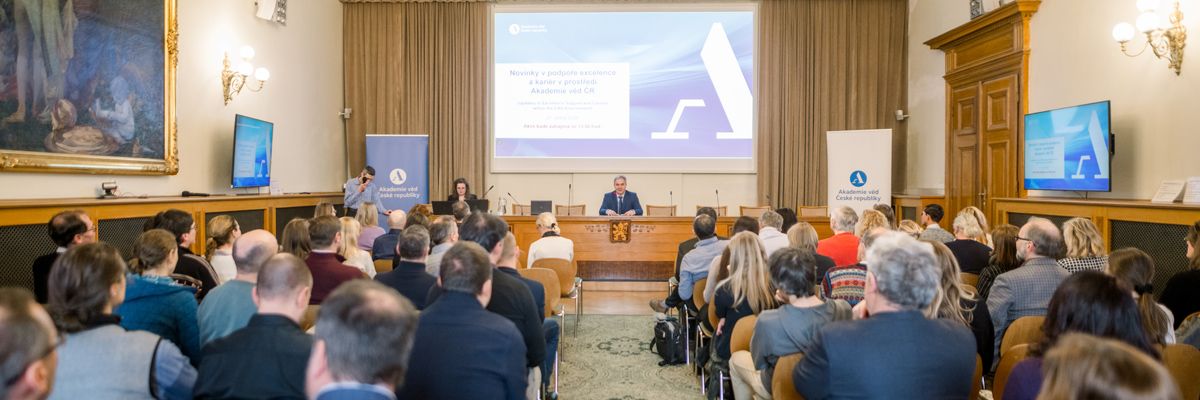
“Supporting excellence in research is an important part of the agenda of the Academy Council. That’s why we were looking for ways to link existing tools with new ones that reflect the needs of the CAS institutes and the changing scientific environment,” emphasized Radomír Pánek, CAS President, at the seminar What’s New in Supporting Excellence and Research Careers at the Czech Academy of Sciences. The event took place on 21 January 2026 at the CAS headquarters on Národní Street in Prague.
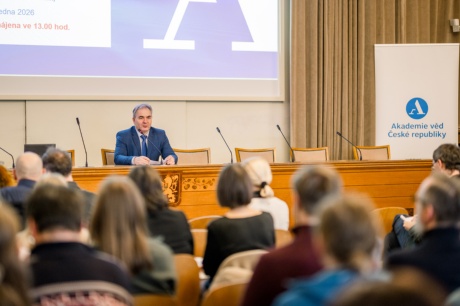
Comprehensive support for excellence and research careers is a top priority for CAS President Radomír Pánek.
How to support excellence in research?
At the seminar, Petr Baldrian, who coordinates the agenda of excellence support programs within the Academy Council of the CAS, explained that changes to internal support are based on the substantive framework of three new directives. These unify existing and new tools: “We have divided the programs into three areas – support for excellence and careers at the CAS institutes, recognition of scientific excellence, and support for research projects, including those with potential for commercial application.”
Existing programs – the Academic Award (Praemium Academiae), the Lumina Quaeruntur fellowship, the Program for the Support of Promising Human Resources, and the Otto Wichterle Award – will remain in place. However, some will undergo partial adjustments in connection with the new directives.
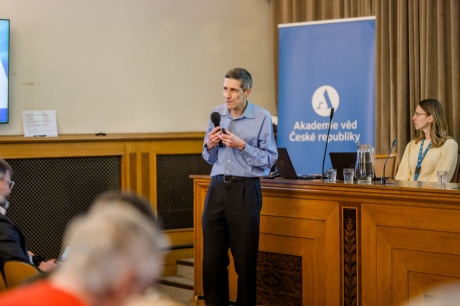
The revised support system within the Academy was presented by Petr Baldrian from the Academy Council of the CAS.
The Academy we want
The Academy of the Future program is expanding existing support by means of seven programs focused on fellowships, researchers returning, the recruitment of international experts, and the development of research groups. As Baldrian explained, the Academy Council of the CAS proposed the program as a tool that combines support for individuals and institutes alike: “This has created a framework for developing scientific careers from the earliest stages through to supporting already established teams.”
Available financial support for the Academy of the Future program is expected to reach up to CZK 170 million (approximately EUR 7 million) in the coming years. “We plan to maintain funding for the existing programs – the Academic Award, Lumina Quaeruntur, the Otto Wichterle Award, and the Program for the Support of Promising Human Resources – at their current levels,” Baldrian noted.
As early as 2026, four Academy of the Future programs will receive funding: fellowships for early-career researchers, fellowships for more experienced scientists, support for the dissemination of good practice in institutional support for excellence, and researchers returning from career breaks.
The CAS institutes will receive an annual financial allocation determined by their size, expressed as the number of full-time research staff. Decisions on how the funds are distributed will be made directly by the CAS institutes themselves. “We want to strengthen their responsibility and enable them to support their employees as well as their own institutional development,” Baldrian continued.
In 2027, additional programs will be gradually implemented to help attract top researchers to the Czech Academy of Sciences and to make the institution more competitive at the international level.
ERC-in to support researchers and CAS institutes
Grants from the European Research Council (ERC) rank among the most prestigious forms of targeted funding available to researchers in Europe. They support research projects with the potential to push beyond the boundaries of current knowledge across all scientific disciplines. It is therefore no surprise that only the very best succeed. Within the Czech Academy of Sciences, leading roles are played by large CAS institutes such as the Institute of Organic Chemistry and Biochemistry (nine ERC grants awarded), the Biology Centre (seven), and the Institute of Physics (four grants and two co-hosted). At the same time, the Institute of Ethnology has also been highly successful, having secured four ERC grants over the past six years, with the grant holder of the fifth one currently transferring to the institute from the United Kingdom. The institute employs approximately 35 full-time researchers.
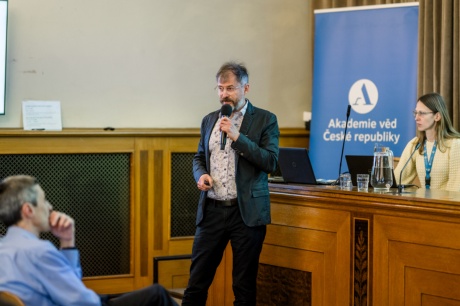
The activities of the ERC Incubator Program (ERC-in) were presented by Luděk Brož, holder of a 2019 ERC Consolidator Grant.
To help CAS institutes improve their success rate with their applications for ERC grants, the Academy Council of the CAS launched a system of centralized support on 13 January 2026 – the so-called ERC Incubator Program (ERC-in). “Its aim is to increase the quality of research at our institutes and to raise both the number of project proposals submitted and those that succeed,” Pánek confirmed. The CAS President also emphasized that the system will take into account the endeavor to retain grant holders at the Czech Academy of Sciences even after their projects end.
The incubator will build on the experience of the CAS institutes mentioned above as well as others and their ERC grant holders. As Luděk Brož explained at the seminar, the program will offer applicants individualized support through career counseling, mentoring, consultations, and preparation for interviews, including so-called mock interviews. “We believe that centralized support for ERC grant applicants will allow know-how to be shared across CAS institutes and will strengthen excellence in research throughout the entire Academy,” Brož noted.
More detailed information about the Academy of the Future program and the ERC Incubator (ERC-in) will be available in interviews with Petr Baldrian and Luděk Brož, to be published in the coming weeks.
Prepared by: Luděk Svoboda, External Relations Division, CAO of the CAS
Translated by: Tereza Novická, External Relations Division, CAO of the CAS
Photo: Pavlína Černoch Jáchimová, External Relations Division, External Relations Division, CAO of the CAS
 The text and photos are released for use under the Creative Commons license.


Read also
- Could an asteroid hit Earth? The risk is low, but astronomers are keeping watch
- At the nanoscale, gold can be blood red or blue, says Vladimíra Petráková
- The beauty of Antarctic algae: What can diatoms tell us about climate change?
- Moss as a predator? Photogenic Science reveals the beauty and humor in research
- How does the Academy Council plan to strengthen the Academy’s role? Part 2
- How does the Academy Council plan to strengthen the Academy’s role? Part 1
- Ombudsperson Dana Plavcová: We all play a role in creating a safe workplace
- ERC Consolidator Grant heads to the CAS for “wildlife on the move” project
- A little-known chapter of history: Czechoslovaks who fought in the Wehrmacht
- Twenty years of EURAXESS: Supporting researchers in motion
The Czech Academy of Sciences (the CAS)
The mission of the CAS
The primary mission of the CAS is to conduct research in a broad spectrum of natural, technical and social sciences as well as humanities. This research aims to advance progress of scientific knowledge at the international level, considering, however, the specific needs of the Czech society and the national culture.
President of the CAS
Prof. Eva Zažímalová has started her second term of office in May 2021. She is a respected scientist, and a Professor of Plant Anatomy and Physiology.
She is also a part of GCSA of the EU.